Minnesota's Raptors

Otus asio
Eastern Screech-Owl
Named for their distinctive cry, the screech owl is a small bird, often with gray or red-brown coloring. Their small ear tufts and yellow eyes are also common identifiers. For hunting, they can usually be found stalking insects, rodents, or even smaller birds.

Bubo virginianus
Great Horned Owl
A large owl known for their signature feather tufts resembling horns, these predators are renowned for their efficiency. Coloration varies from red-brown to white, black, and gray. While they can go for larger prey like hawks, Great Horned Owls tend to favor mice and similar small rodents for the majority of their diet.

Surnia ulula
Northern Hawk Owl
Though they are owls, these birds look and act deceptively similar to hawks. It is one of the few owls to hunt diurnally, and it's flight patterns and general appearance are far more similar to those of typical hawks. They often have brown back feathers with a white, striped chest and belly, but are rare sights in Minnesota.

Strix varia
Barred Owl
Barred Owls are one of the most commonly sighted owls in Minnesota, and are known for their eerie calls. They are medium sized birds, with dark concentric rings around its face. They look similar to Great Horned Owls, though lack their distinctive ear tufts and tend to be smaller; they also have notably dark eyes, in contrast to most Minnesotan owls' yellow eyes. They often hunt small mammals and fish.

Strix nebulosa
Great Gray Owl
The largest North American owl, these large birds are known for their distinctively deep calls and diurnal hunting. It can be spotted by its long streaks across its otherwise white chest, as well as a long tail and lack of ear tufts. Once they find their prey, often rodents, they dive directly for them in an attempt to capture it in their talons.

Asio otus
Long-eared Owl
A smaller bird of prey, these camouflaged hunters are notable for their ability to hunt in complete darkness and coloration resembling tree bark. Their name comes from their long ear tufts, and their feathers are colored with dark bars and streaks along their body and wings, with a brown-orange face. For hunting, they tend to favor rodents and other small animals that spend their nights in open fields.

Asio flammeus
Short-eared Owl
A small raptor with large wings, these owls are easily identified by their dark wrist marks and black wing tips. Their fluttery, "moth-like" flight pattern also makes them easier to spot during their diurnal hunting. Their plentiful wing markings and significantly smaller ear tufts separate them from their long-eared cousins.

Aegolius funereus
Boreal Owl
One of America's smallest owls, these owls are very similar to the more common Northern Saw-whet Owl. Comparatively, the Boreal Owl has a gray crown and forehead with lighter, fine streaks compared to the NSWO's dotted pattern. The Boreal Owl is a rare sight in Minnesota, with a limited known population and dwindling habitat, this species is currently protected.

Aegolius acadicus
Northern Saw-whet Owl
The smallest of Minnesota's owls, the Northern Saw-whet is a common sight. It's coloration is mostly brown, with long white streaks in its back and chest feathers. It can normally be found hunting small mammals like mice and shrews.

Falco sparverius
American Kestrel
The most common falcon in North America, the Kestrel is a lean and swift hunter, often going after insects and small mammals. Males tend to have gray wings with black spots, white underwings, and a rust-colored brown on its back. Females, however, have more diffused brown coloration, and their tails have significantly more brown with narrow black barring compared to the male's.

Falco columbarius
Merlin
Stocky compared to its smaller size, the Merlin is a varied bird. Males often have more grayish coloring, with a brown underbody with less streaked pattering, while the females consist largely of various browns, often looking similar to nestlings. It's flight feathers and tail have distinct black bands, which can make identification easier. Merlins tend to eat other birds, chasing and catching them out of the air.

Falco peregrinus
Peregrine Falcon
Potentially the widest ranging raptor in the world, the Peregrine is distinct for its long, pointed wings and narrow tail. Adults tend to have blue, slated markings along the length of its body, with a white throat and underbelly. While its beak, eyes, and wings are yellow like It's flight pattern is more narrow, aiding in direct pursuit of its common prey, smaller birds.

Pandion haliaetus
Osprey
Unique enough to gain their own genus, the Osprey has a very long history. It appears in the fossil record as far as 23 million years ago, with a claw discovered in Egypt. With a diet consisting almost entirely of fish, the Osprey is uniquely suited for aquatic hunting. Its white breast and glossy brown back and wings are resistant to water, letting it hunt for fish with little issue.

Haliaeetus leucocephalus
Bald Eagle
Named for its famous white head, the Bald Eagle is a sea eagle which primarily hunts for fish. It is an opportunistic feeder, finding and swooping for nearly whatever it considers food. It's relatively easy to spot, in large part thanks to its protected status and American symbolism, but it's white head and dark brown body are instantly recognizable.

Circus hudsonius
Northern Harrier
A migratory hawk, the Harrier has the longest wing and tail relative to its body size of all American raptors. Nearly silent hunters, they tend to favor small mammals and birds, which they dive for once they spot. Most have largely dark brown plumage, but males are known for having a ghostly gray coloration, especially under their wings and bellies.

Accipiter striatus
Sharp-shinned Hawk
A rather small bird, the Sharp-shinned Hawk, or "Sharpie," is an excellent hunter in dense forests. They can often be spotted by their gray backs and wings, though chest color varies based on subspecies.

Astur cooperii
Cooper's Hawk
Often gray in coloration with blue or brown hues, the Cooper's Hawk is one of the longest lasting species of raptor in the Americas. Its distinctive head shape and darker coloration can set it apart from other local species, though the three dark bands along its tail and whitish wing tip are good identifiers. They hunt a wide variety of prey, taking advantage of whatever they can.

Astur atricapillus
Northern Goshawk
While a nestling it can often be confused for similar species like the Cooper's Hawk, it becomes more distinct in adulthood. Its gray-brown back and rounded head shape can make it hard to distinguish from other hawks, but its banded pattern along its chest is an easy identifier. They are opportunistic predators, though they often target smaller birds.

Buteo lineatus
Red-shouldered Hawk
Though its orange coloration it's named after is a prominent identifier, the signature "shoulders" can only be seen while it is perched. They can be spotted by their brown heads, long tails, and distinct white bars along its wings and chest. They hunt by dive bombing their prey, often going after larger rodents or birds.

Buteo platypterus
Broad-winged Hawk
With a dark brown body and paler chest, these birds are often confused with the Red-shouldered Hawk. Though they do have similarly orange-ish upper bodies and scattered white along its lower body, they lack the prominent bands or long tails found in Red-shouldered hawks. Commonly opportunistic predators, their diet tends to shift with the seasons depending on what is available.

Buteo swainsoni
Swainson's Hawk
The "light-morph" variety found more commonly in the Midwest is known for its paler coloration, with a whiter lower body and white throat patch. Apart from this paler complexion are their dark flight feathers and pale-gray upper body. These birds are known to still-hunt, where they stay perched on a high object and wait for unaware prey to wander close.

Buteo jamaicensis
Red-tailed Hawk
One of the largest and most common falcons in North America, these birds are a common choice of companion for falconers. While they have several subspecies, they can generally be identified by a white underbelly and darker band along the chest, as well as the prominent brick-red tail. Their diet generally consists of smaller mammals and rodents, but this can vary depending on the seasons.

Falco rusticolus
Gyrfalcon
The largest species of falcon in the world, the Gyrfalcon is found in high altitude tundras in northern regions. General coloration is white, silver, or black; though these can vary depending on the individual. Darker coloration is more prominent in females, however. They tend to hunt mammals, with a more pursuit based hunting strategy compared to other falcons.

Falco mexicanus
Prairie Falcon
Often mistaken for the Peregrine Falcon, these birds are often found in the Western United States, though can be spotted in Minnesota. They are more a warm brown coloration than the Peregrine, and lack the district yellow coloration of the eyes and beak. Their chest is also more spotted with brown dots than the Peregrine. While it is opportunistic like most other falcons, this bird often hunts small mammals or birds, which it takes back to its nest before consuming.

Athene cunicularia
Burrowing Owl
A primarily grounded owl, these birds often roost in burrows, though it does not make these tunnels themselves. They are diurnal, primarily being active in the day unlike most owls, and retreat into their burrows at night. They lack the ear tufts of many other owls, and a distinct white chin patch can be seen during certain aggressive or mating behavior. They are generally a lighter brown with spotted white coloration, though this pale color may be obscured by dirt. They are still-hunters, perching and waiting until they spot prey to pursue, usually insects.
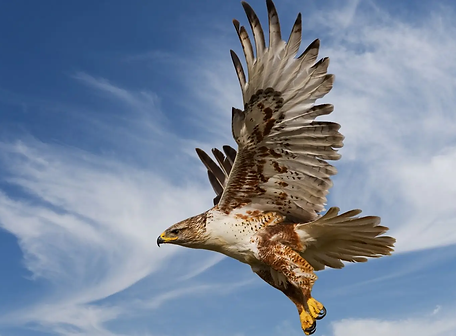
Buteo regalis
Ferruginous Hawk
Generally a brownish rust color along the main body, though the head and breast are whiter. Notably long wings, with wingtips nearly reaching the tip of the tail while folded. Spotted brown coloring along the otherwise white wings. Generally hunt medium sized mammals, though they have been known to eat birds and insects as well.

Elanoides forficatus
Swallow-tailed Kite
A stark contract of black and white defines the Swallow-tailed Kite's coloration, with its signature forked tail and long wings visible both while perched and in flight. They are often found in Central America and the southern United States, though they have been brought to Minnesota. Generally they feed on reptiles and insects, though they also eat fish when available.